MegaCorp Industries
MEGAOpens before the numbers say it should. It moves on daylight, not on proof.
Aggressive expansionist
One city · One order book · No pause button
A free browser business sim: one shared city, 179 products, a live stock exchange, and twelve rival corporations that keep building and trading at one game day every ten seconds.
$500,000 starting capital · free in any browser · no download
There is no payment system in the game. Nothing to buy, nothing to pay to catch up.
The clock
That sentence is not marketing. It is the first thing the game says to you when you come back — followed by exactly how many days you missed.
One tick is one game day, and a tick lands every ten seconds. The tick engine runs on the server whether anybody is connected or not, so nothing waits for you: businesses produce, prices move, the AI corporations act, and your last limit order sits on the book exactly where you left it.
The city
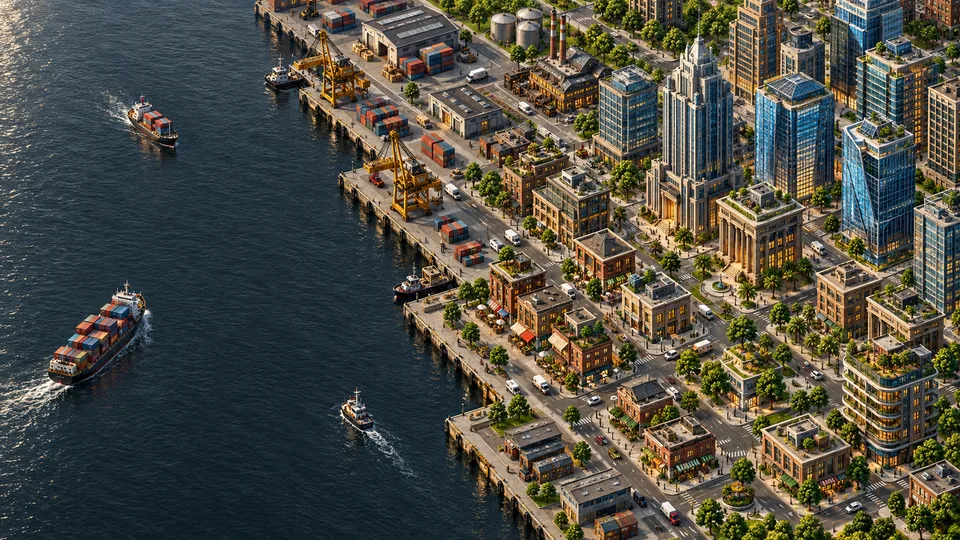
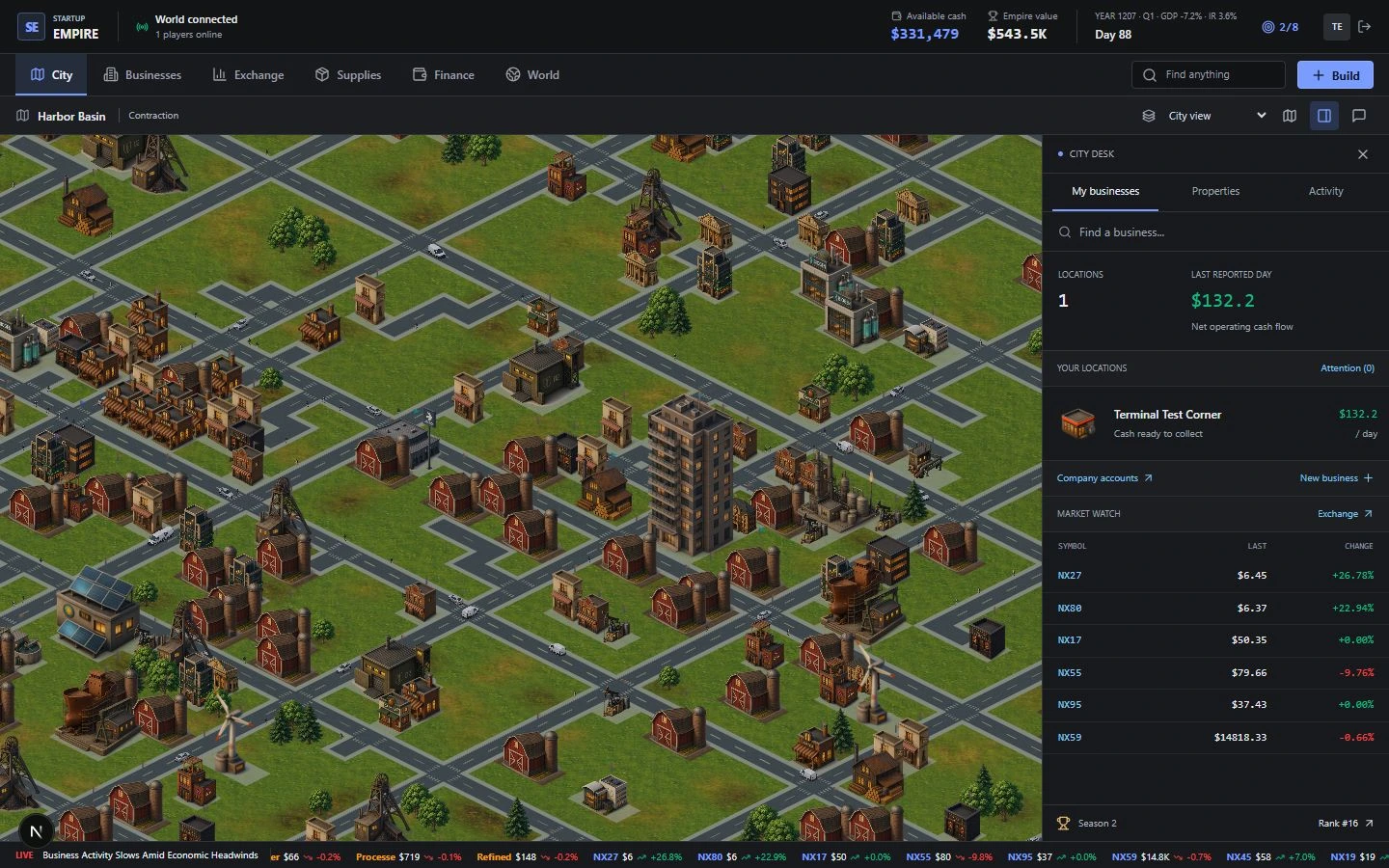
Pedestrians walk the sidewalks and traffic runs the roads, and the density is driven by real economic activity — a busy commercial block teems, a closed shop generates nothing at all. Twelve kinds of finite resource sit under the ground and deplete as they are worked. Roads extend as the city builds out.
The competition
They buy land, staff their floors, cut prices, list on the exchange, short what they think is overvalued, and bid for companies they want. They act every fifth tick, staggered per company, so you cannot time them.
Opens before the numbers say it should. It moves on daylight, not on proof.
Aggressive expansionist
Runs the thinnest cost base in the city and prices under you until your margin is gone.
Cost minimizer
Out-researches you first, then beats you on the quality half of the rating.
Tech innovator
Buys energy, finance, real estate and media until a sector has one seller left.
Monopoly builder
Doesn't build. Buys.
Financial raider
Charges more than you and still takes the demand.
Luxury strategist
Lends, collects, compounds. In the world we photographed for this page, it was ranked first.
Bond king
Sells your stock before it owns any.
Short shark
Collects companies across sectors and calls it strategy.
Conglomerate builder
Owns the one sector nobody else wants badly enough.
Defense contractor
Pays up for talent, then owns the grid.
Green energy
Twelve corporations are dealt across those eleven archetypes at world start, and the world respawns entrants to keep the field full. If one of them dies, another one is already coming.
Stakes
None of these are cutscenes. All four are rules the simulation runs every tick.
01
A rival does not grow your market. When a second seller enters your product's demand pool, total demand rises by 25% — the rest is taken off you, split by a weighted blend of quality, price and brand whose mix differs product by product.
02
Go public and your ticker becomes a target. Short selling, margin and bonds are all live, and one archetype exists to do nothing else.
03
Anyone holding 5% of your shares can open a hostile tender at a 10% to 100% premium. They must escrow 100% of the bid in cash first — no paper bids — then a 40-tick window runs. At 50.1%, the company is theirs.
04
The SEC watches insider trading and manipulation. The IRS audits and reclaims back taxes. Antitrust opens above 40% share of a sector. Win too hard and the case is yours.
Supply
179 products, 151 of them with real input recipes across 14 sectors. Buy your inputs on the open market and a rival can squeeze you. Make them yourself and they can't.
Recipe — food
Recipe — heavy industry
Both of those are literal recipes in the product table, not illustrations.

The exchange
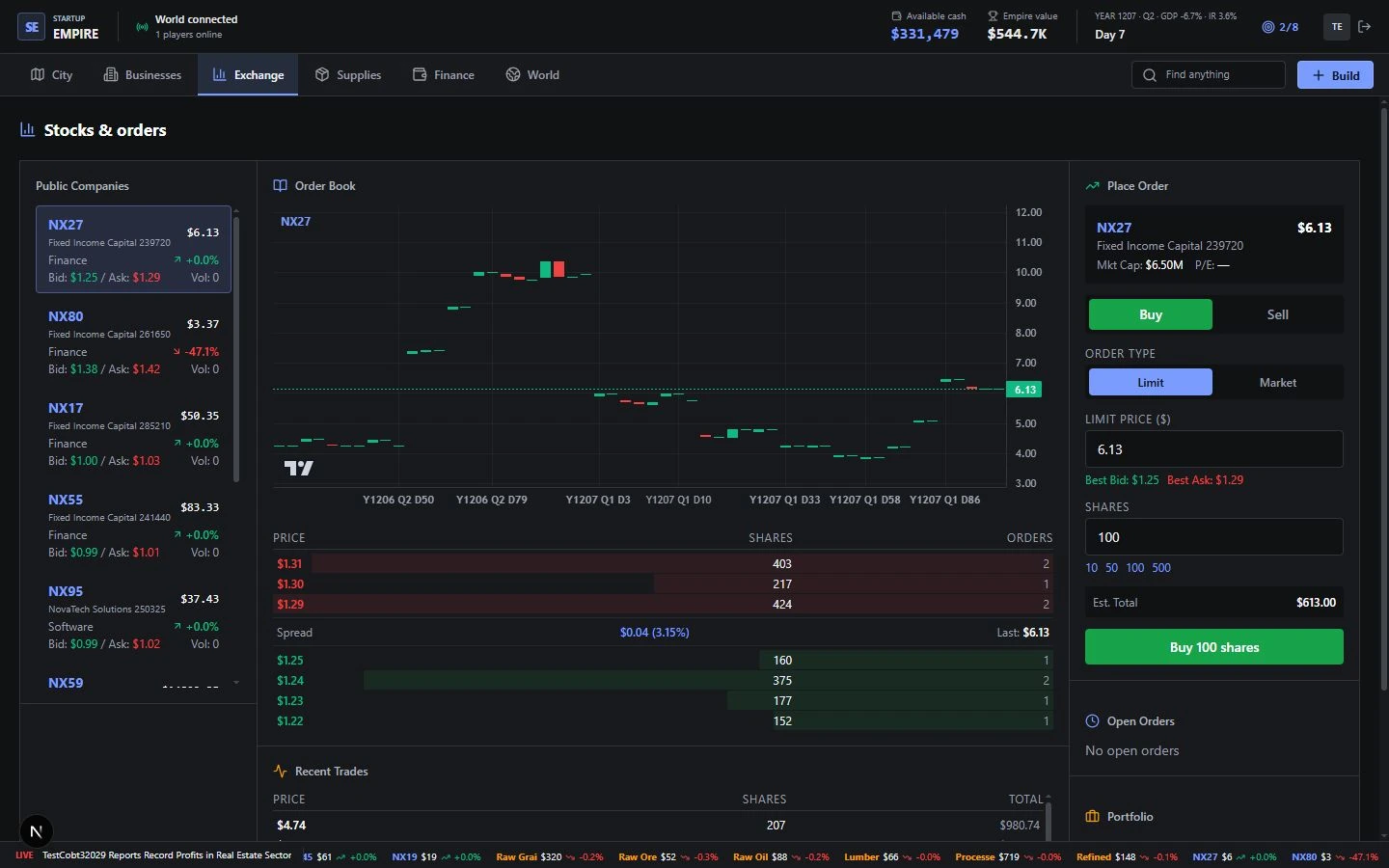
One shared exchange. Price-time priority, partial fills, ten levels of visible depth, and a spread you have to cross or wait out. Take a company public and it lists here for everyone.
IPOs have real listing gates — ten employees and fifty thousand in assets before you can ring the bell. After that: dividends, bonds, margin, short selling, and anybody with 5% of your stock able to come for the rest of it.


One shared book per public company, with partial fills. Your limit order queues behind the one that got there first, at the price it got there at.
Every portfolio, plus the market maker's inventory, minus every open short, must equal shares outstanding. The harness asserts it every tick — 1,500 ticks, zero violations. The market maker can only sell shares it actually holds.
Every economic command carries an idempotency key. We killed the production process with SIGKILL after the receipt, after the checkpoint and after the response — the order neither vanished nor charged twice.
The season
A growth season runs one real week — 60,480 ticks, which is 168 game years — and it scores wealth gained, not wealth owned.
When it ends there is a one-hour intermission, the top twelve are archived as champions, and the growth baseline resets. Nothing is wiped: your buildings, your companies, your holdings and your position on the map all carry into the next race. You don't start again. You start from wherever you got to, one place further down the list of people who didn't stop.
Seven categories of world news, generated from events that actually happened: a supply squeeze, a liquidity crunch at a named corporation, a competitor opening on your street. There's a morning briefing with GDP, the interest rate and a sector-by-sector outlook, and a ticker along the bottom of the city with live commodity and equity prices.
Headlines from a running world
Day one
The city is already running when you get there. That's the point — and it's also why the opening is made as easy as we could make it.
A corner store, a neighbourhood grocer or a fashion boutique — each arrives with its purchase and sales departments already placed in the 3×3 grid, and the boutique with advertising on top. Nothing has to be assembled by hand.
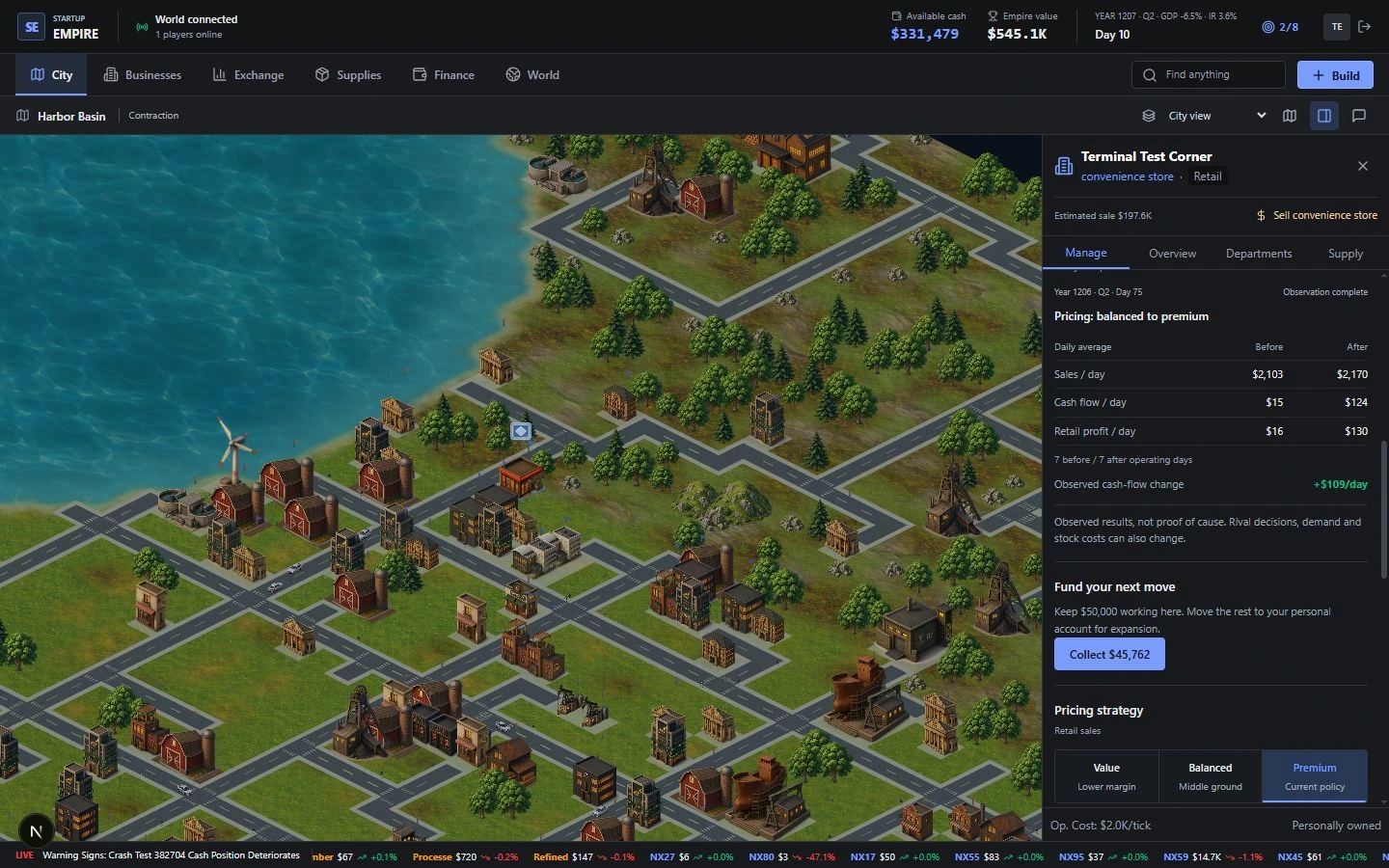
Pick a lot and the game quotes structure, land and $50,000 of working capital as one number, next to your available cash and what you'd have left. Nothing moves until you confirm.
A failing shop stops trading rather than draw its funder below $100,000. It can lose you a business. It can't lose you the last of your money.
Hold property personally, or incorporate, list, pay yourself a salary and a dividend, and use the company's balance sheet to fund the next one.
Questions
Yes. Free, in a browser, no download. There is no payment system anywhere in the game — no shop, no premium currency, no subscription, nothing to buy and nothing you can pay to catch up with.
No. If you have, you'll recognise the demand model immediately and you'll be dangerous inside an hour. If you haven't, you open a corner store, sell snacks, and learn the rest of it by watching what the city does back to you.
No — but the world doesn't wait. One game day lands every ten seconds whether you're there or not, your businesses keep operating, and the AI corporations keep acting. There's no daily bonus to miss and nothing to collect for showing up. What you miss is time, and time is the only thing anyone here is actually competing for.
Your businesses keep producing and selling, your orders stay on the book, prices move and rivals act. When you come back the game opens with a briefing: how many game days passed, and how your empire value and personal cash changed over them.
Both, in one world. Twelve rival corporations run continuously from eleven behavioural archetypes, and every human in the world trades on the same order book and competes for the same customers in the same demand pools.
Only if you take it public. Anyone holding 5% of your shares can open a hostile tender offer at a 10–100% premium with 100% of the bid escrowed in cash, a 40-tick window to decide, and control at 50.1%. Stay private and nobody can bid. Go public and you get liquidity, an IPO valuation, and a permanent risk that somebody wants your chair.
Three plans arrive pre-configured, and the game quotes the entire opening cost — structure, land and working capital — before any money moves. There's no tutorial and no quest chain: there's a pre-configured plan, an itemised quote, a protected reserve, and a business list that sorts itself by whatever is about to go wrong.
Pick one of the three plans, choose a lot on the map, read the quote, and confirm it. Your shop gets built, staffed and stocked, and starts selling. After that: set your pricing, watch what the demand split does to your margin, collect surplus cash when it builds up — and open the exchange to see what the twelve corporations are worth.
The city is open for business
$500,000, one shared city, and twelve corporations who were already here when you arrived.
Free in any browser · no download · nothing to buy